Professional facade cleaning by drone
A modern, safe and cost-effective cleaning solution for high-rise facades — without scaffolding or rope access.
Excellent results, minimal disruption, lower total cost.
For the exterior cleaning of office buildings, hotels, industrial halls, logistics centres and other commercial buildings.
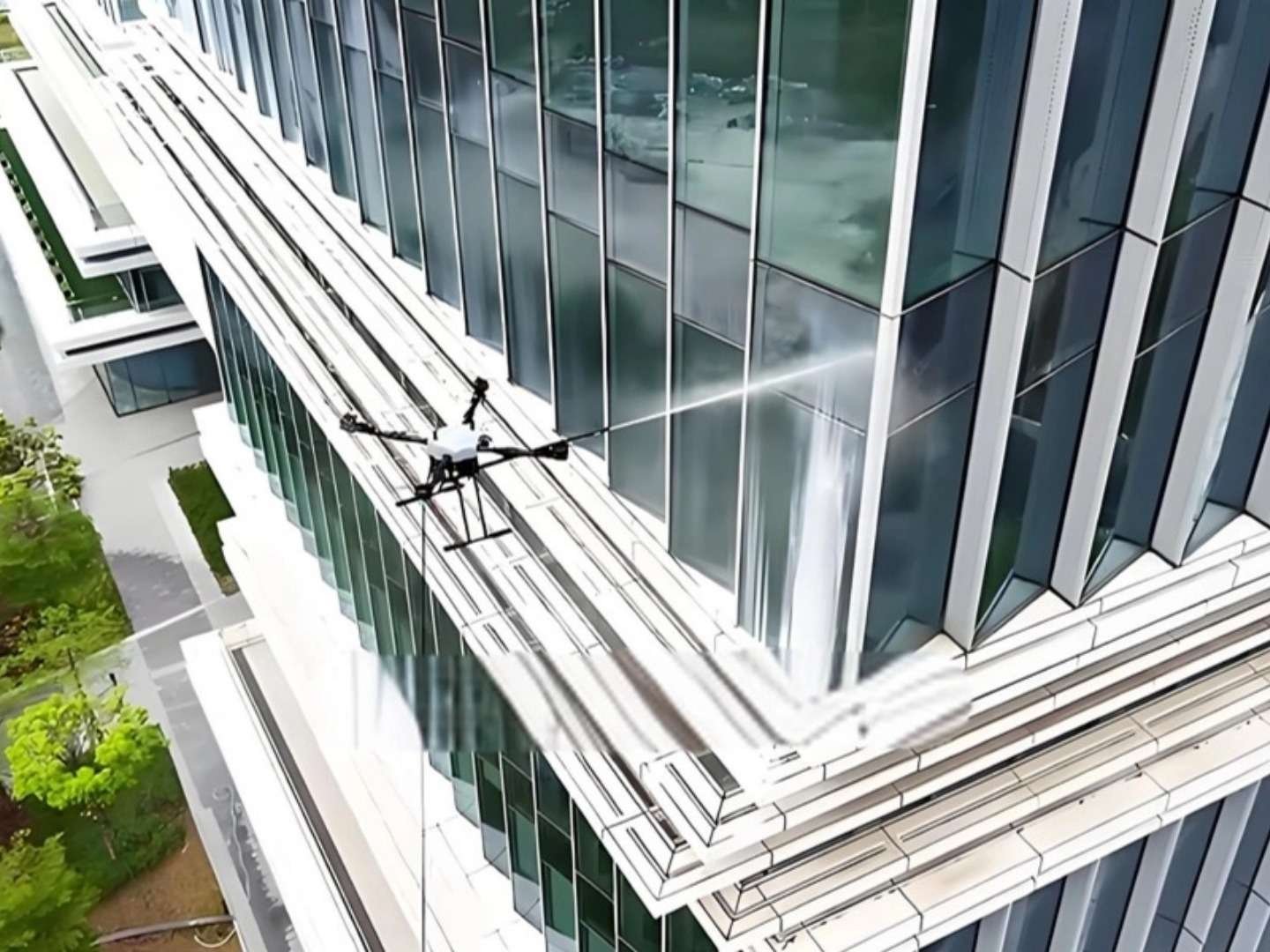
The challenges of traditional cleaning and rope access
Classic facade cleaning methods come with significant risks and limitations.
Rope-access risk
A dangerous, accident-prone method for facade cleaning at height.
Slow and expensive execution
Traditional cleaning methods are time-consuming and involve significant labour costs.
Hard-to-reach surfaces
High facade sections can hardly or not at all be reached with traditional equipment.
A modern, future-proof solution — with the safety and efficiency today's standards demand
5–10x faster execution
No scaffolding or rope rigging needed — the system is typically ready within 15 minutes and can clean large surfaces without interruption.
Safer
No dangerous scaffolding or rope access — the pilot and operating crew stay on the ground throughout.
Streak-free, aesthetic result
Controlled-pressure, water-based cleaning on glass, metal and painted surfaces, along a documented flight path.
Chemical-free solution
An environmentally friendly process that is gentle on the surface — by default using only pure, osmosis-treated water.
Ideal for large surfaces
Excellently suited to large, tall facades as well, with uninterrupted sweeping movement.
Documented process
The entire workflow is traceable: we record the washing data and the flight log, and can report on them.
World-class technology, a transparent working method — with measurable results
World-class technology
An industrial-grade drone system, equipped and certified specifically for facade and window cleaning.
Certified safety
A standardised safety protocol (SOP) and full liability insurance on every project.
Environmental awareness
Chemical-free cleaning technology that is gentle on the surface, working by default with only pure, osmosis-treated water.
Documented report
We record the washing data and summarise it in a report, so you can see exactly what you got for your money.
Highest level of privacy
The pilot uses the camera for navigation only — we do not record images or footage.
One-Stop Shop
Where drone technology is not enough — for indoor surfaces or hard-to-reach areas — our own industrial rope-access team complements the drone.
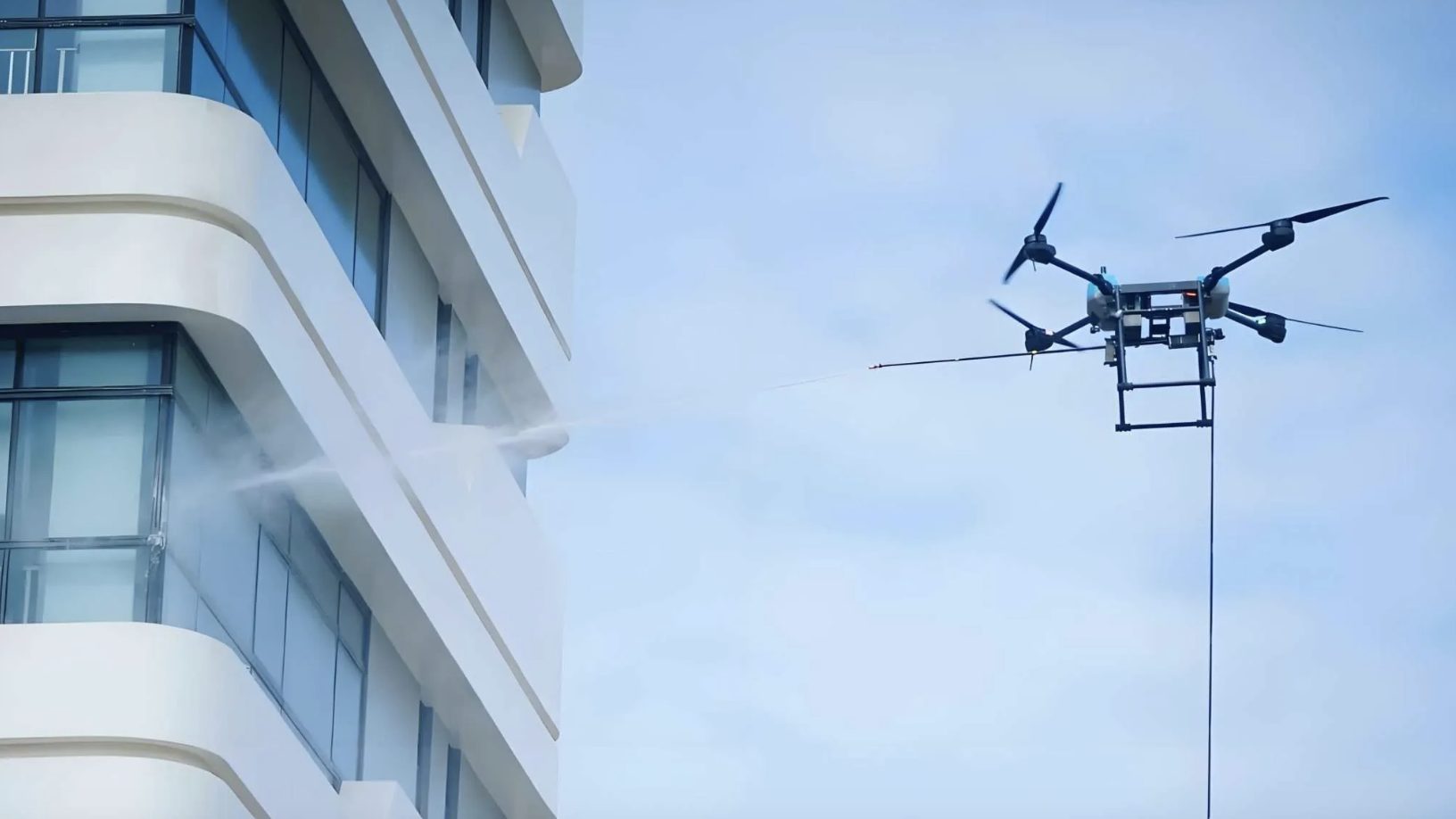
Industrial cleaning drone designed specifically for facade cleaning
High water pressure
Max. 160 bar, effective and thorough cleaning at every soiling level.
Dual RTK stabilisation
Centimetre-precise positioning close to the wall during flight.
Industrial hose system
Stable operation even at great height, with continuous power and water supply.
Up to 600 m²/h
Outstanding cleaning efficiency even on large facades.
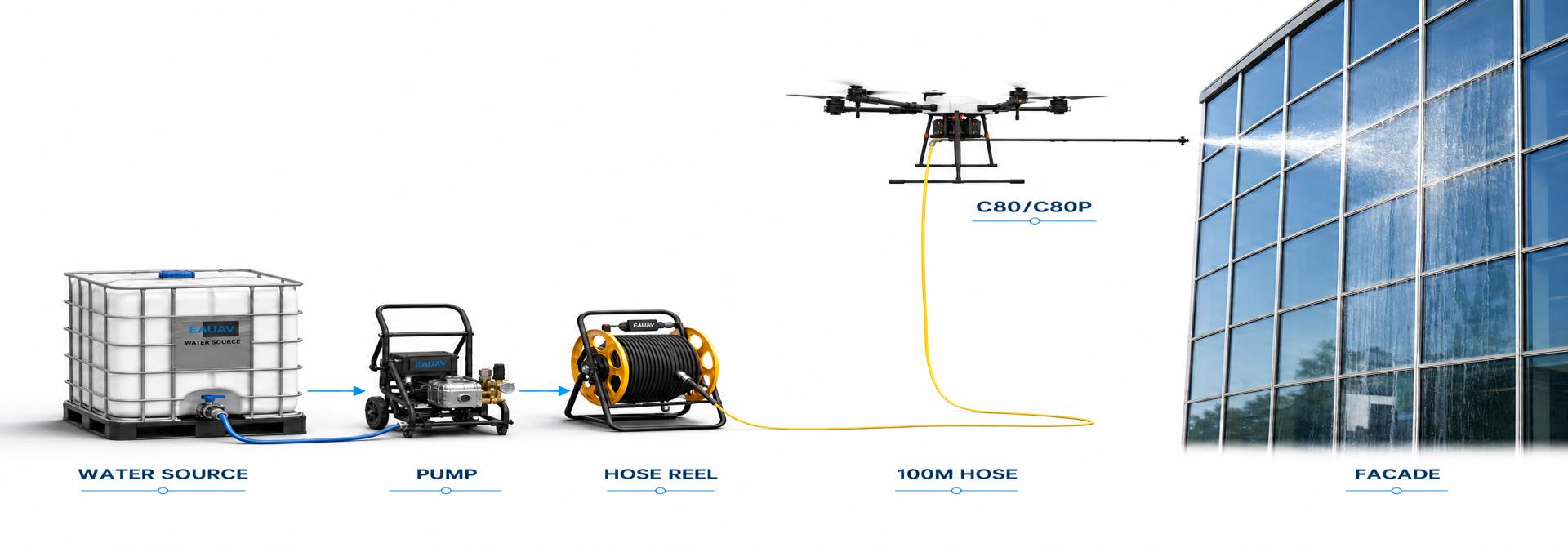
Water source → pump → hose reel → 100 m hose → drone
The weight of the water and pump stays on the ground, so the drone near the building remains lighter and more precise.
Standardised processes, a multi-level safety protocol — on every project
SOP-based operation
Standardised procedures guarantee high quality and safety on every project.
Max. 8–10 m/s wind limit
Our drones fly only in safe wind conditions.
Wide-spray water jet
A gentle cleaning method that does not damage the surface.
Dedicated tether handler
Handling the tether is the task of a dedicated specialist during every flight.
RTK distance keeping
Precise navigation to hold a constant, safe distance from the facade.
Full liability insurance
The service carries full liability insurance on every project.
Five steps from assessment to verified result
On-site assessment
Survey of building height, facade geometry, pedestrian and traffic zones, wind conditions and water access.
Surface and soiling analysis
Identifying glass, metal panel, stone or painted surfaces; assessing the type of soiling.
Test patch
We first test the planned method on a smaller, representative area before treating the whole facade.
Exclusion zone and safety plan
Setting up the take-off and landing zone, hose routing, pedestrian exclusion zone and emergency-stop protocol.
Cleaning and documentation
Cleaning under pilot supervision, followed by recording of the washing data and flight log, and reporting.
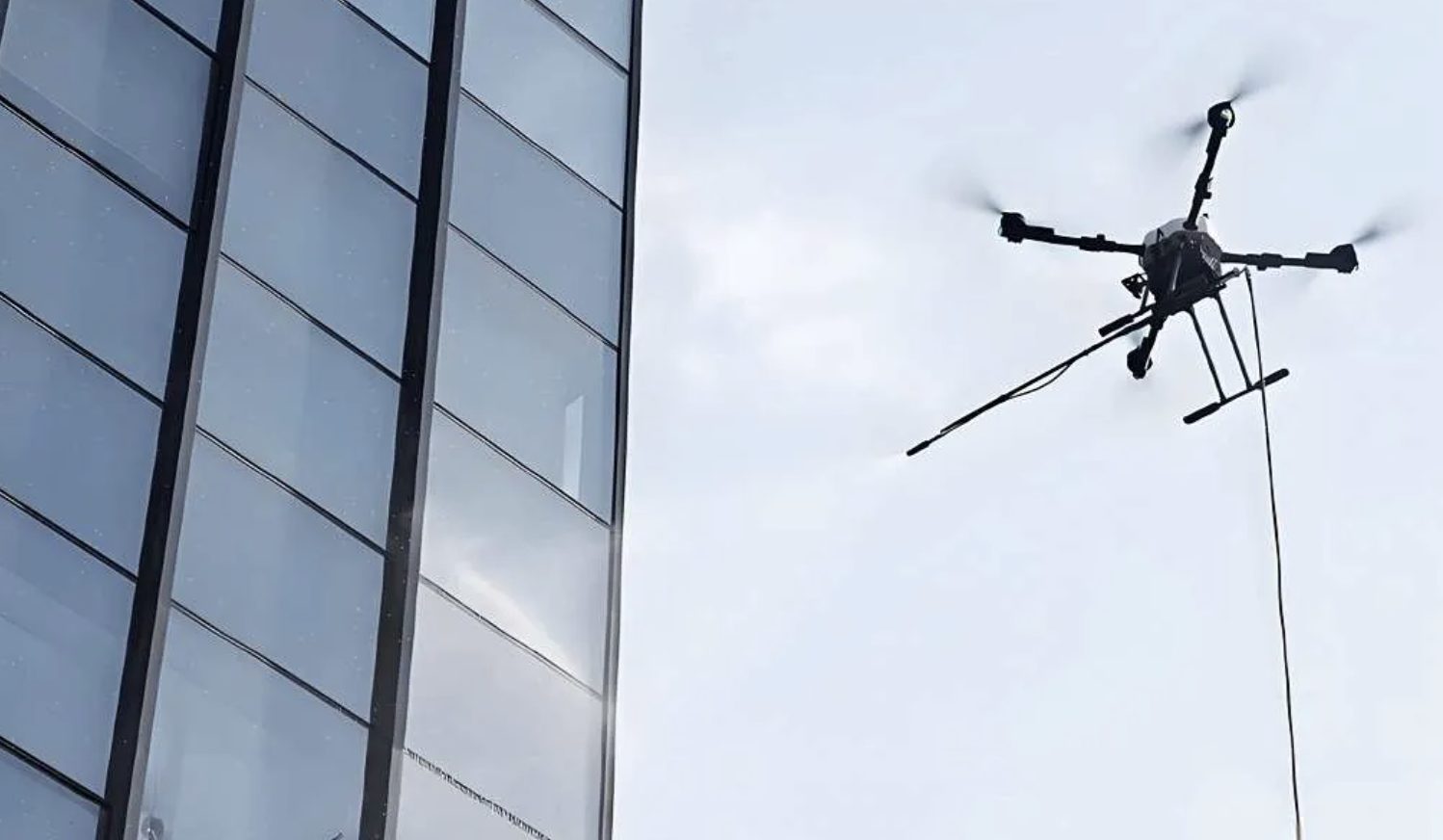
Ideal for large, glazed and industrial facades alike
Glass office buildings
Hotels
Industrial halls
Logistics centres
Sports halls
Stadiums
Event centres
Wind turbines
Silos
Industrial chimneys
Chemicals only when truly necessary — 0 ppm, osmosis-treated water
What does 0 ppm mean?
ppm (parts per million) measures how much dissolved mineral matter is left in the water. Tap water is typically 150–400 ppm — these minerals leave spots and streaks behind as it dries. Water treated with reverse osmosis and ion exchange is practically 0 ppm, i.e. it contains no dissolved minerals.
Why does "empty" water clean better?
Water at 0 ppm contains no dissolved minerals, so it is chemically "hungry" — when it reaches a surface it attracts and dissolves the dirt and mineral deposits on it instead of just running over it. This is also why pure-water-based, chemical-free technology has become widespread in the professional window-cleaning industry.
Spot- and streak-free drying
Because the water has nothing to leave behind, the surface dries on its own without mineral spots or streaks — no wiping or polishing afterwards.
When chemicals are still needed
For heavier soiling (e.g. graffiti, industrial grease or soot deposits) we use biodegradable, surface- and environment-friendly products from one of Europe's leading cleaning-chemical manufacturers — after cleaning they can be discharged into the sewer system, and the rinse water can even be used to water plants. By default, however, we use only pure, osmosis-treated water, without chemicals.
It's not just "a dirty window" — we know exactly what we are dealing with
Graffiti and urban soiling
A common problem on city-centre office buildings — we use a cleaning method matched to the surface type so that the coating is not damaged.
Industrial dust and soot deposits
A typical, persistently recurring soiling on buildings near factories, logistics centres and busy roads.
Algae growth, rain streaking
An aesthetically disturbing change that appears on shaded, north-facing glass facades and with mineral deposits.
What our clients ask most often before the assessment
The exact figure depends on the facade geometry and the level of soiling, but we are typically talking about a 5–10x speed advantage, because no scaffolding or rope rigging is required.
Our technology operates routinely and safely at heights above 120 metres. The exact reachable height also depends on the facade geometry, wind conditions and on-site circumstances, which we clarify during the assessment.
Ideally dry, stable weather. In strong wind, rain, frost or snow we postpone the work for safety reasons and agree on a new date.
We treat glass curtain walls, coated metal and aluminium panels, painted surfaces as well as stone and concrete — the method is always adapted to the surface, and on sensitive surfaces we start with a test patch.
Not by default — we use only osmosis-treated, 0 ppm water, which cleans without chemicals and leaves no spots or streaks. For heavier soiling (e.g. graffiti, industrial grease and soot deposits) we use biodegradable, surface- and environment-friendly products from one of Europe's leading cleaning-chemical manufacturers, which can be properly discharged into the sewer system after use.
The ground safety zone is 3–4 metres wide, measured from the facade, and we only ever cordon off the area directly below the drone. The zone moves along in sections as the work progresses, so only the area in front of one facade section is closed at any time — just as with rope-access cleaning. Two people work per drone: one pilot flies the drone, the other is responsible for securing the cordoned area and handling the hoses safely. We separate the work area from pedestrian traffic with warning signs, cones and marker poles.
That depends on the building's location: it typically affects a section of the pavement and rarely the carriageway. If necessary, we consult the local authority and obtain the required permits ourselves. On busier sections we choose, where possible, a time when pedestrian traffic is at a minimum.
The drone has a gimbal camera that helps the pilot navigate and check the condition of the cleaned surface. We do not record any images or video during the operation: the live view appears only on the pilot's display, is not stored and is not transmitted.
The camera's field of view and use are directed at checking the nearby facade surface; it is neither suited nor intended for observing the inside of offices or the people in them. Since no data is recorded, no personal data is processed either. On request we also confirm this in a duly signed declaration.
The maximum water pressure at the pump on the ground is 160 bar. The pressure is regulated and limited at the ground unit and drops further along the hose up to the drone. The drone can work from a distance of 2–3 metres from the glass, so it stays at a safe distance from the building and the direct pressure on the seals is significantly lower.
We work with spray nozzles of different spray angles and always choose the right one for the given surface. Before the work we consult the building operator about the characteristics of the facade and windows and any known defects, and adapt the equipment and technology to them. At the pump we reduce the pressure where necessary.
If damage or water ingress should nevertheless occur during cleaning, we stop work immediately and document the damage on site. We notify the client without delay and report the claim to our insurer. We hold full liability insurance as required. We send the insurance documentation on request.
In our experience it can be carried out routinely and safely if the weather is suitable (wind speed including gusts of at most 8–10 m/s, and no precipitation); water and power supply are available on site, and access and placement of the equipment is resolved; and the annual schedule of official permits and public-space closures can be planned in advance, which considerably simplifies the procedure for recurring work. Surfaces the drone cannot reach (e.g. rear, concealed parts, lifts, recesses) are cleaned by our rope-access colleagues, so the whole facade can be completed in one go. The larger and more continuous the surface to be cleaned, the better the technology performs.